
Given
Fixed-context QA
- Preselected evidence packet
- Question
- Answer
- Evidence is chosen in advance
- One pass, no follow-up inspection
- Tests reasoning over what is shown

Many thanks to contributors: Jing Wang2,3, Hangjie Yuan2,3, Shang Liu2,3
1Durham University2DAMO Academy, Alibaba Group3Hupan Laboratory4University of the Chinese Academy of Sciences
*Corresponding authors
TL;DR We explore how a compact 8B vision–language agent can learn to seek longitudinal clinical evidence — deciding which visit, organ, MRI sequence, slice and tool to inspect — and introduce a longitudinal multimodal benchmark built on UK Biobank to evaluate it.
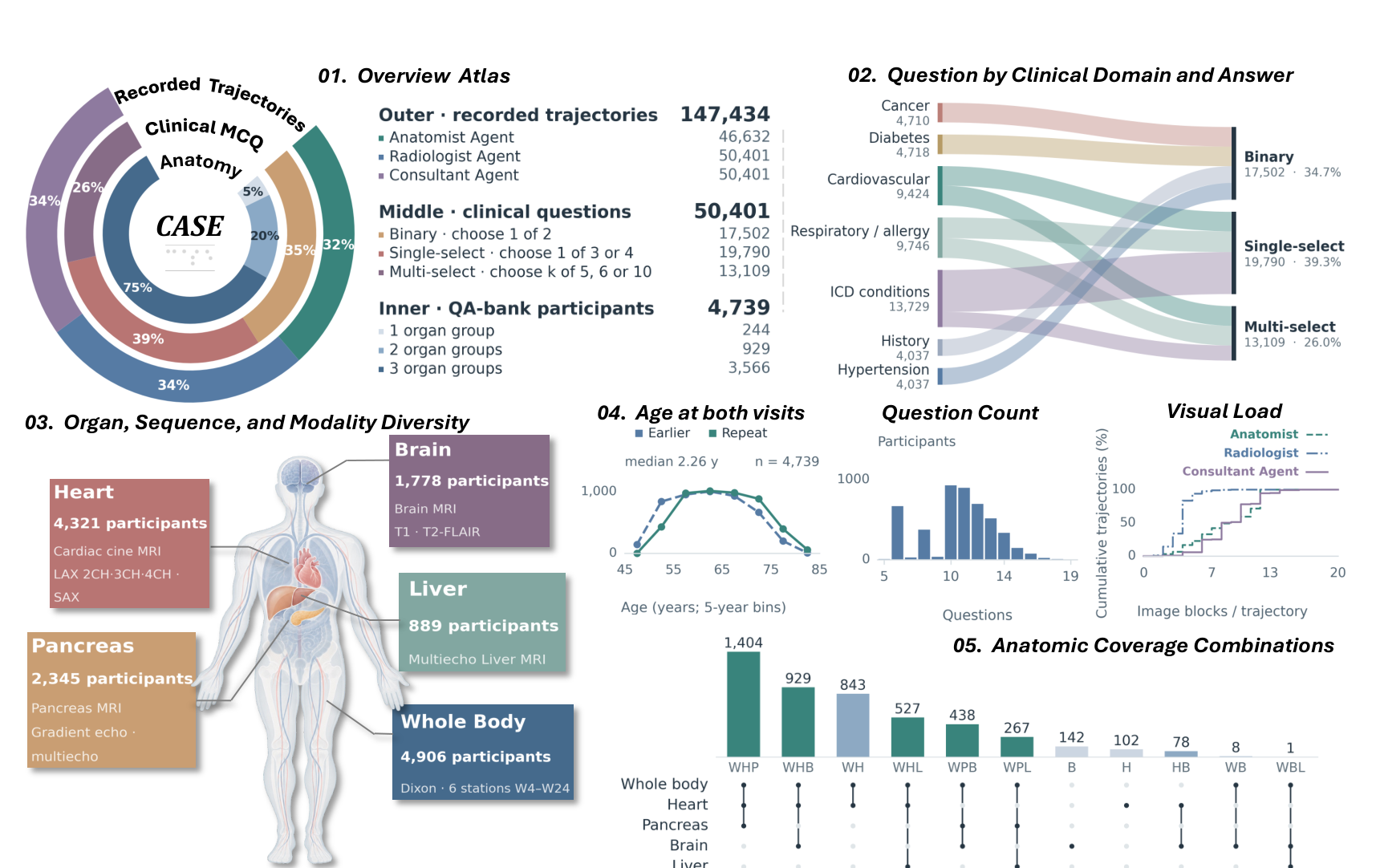
Foundation models can serve as clinical agents through tool-use harnesses. However, conventional medical benchmarks assess reasoning over preselected evidence rather than the ability to seek it across clinical records and longitudinal imaging. We propose CASE: a series of role-specific Clinical Agents for Seeking Evidence, together with a tool-use harness and an agentic post-training framework for compact vision–language policy models. We further introduce a longitudinal multimodal benchmark built on UK Biobank, comprising 50,401 clinical questions derived from real-world ICD-10-coded diagnoses of 4,739 participants. Each question links to a patient-specific environment containing clinical context and multi-sequence MRI from baseline and follow-up visits, where agents autonomously select which visits, organs, modalities, slices, and specialist tools to inspect and compare. Supervised fine-tuning transfers evidence-seeking workflows from 147,434 frontier-model interaction trajectories, followed by agentic reinforcement learning on the learner's own environment interactions. Privileged on-policy self-distillation and rubric-based LLM feedback refine evidence-to-conclusion reasoning without prescribing tool sequences. Experiments show that CASE moves beyond question–answer imitation toward transferable investigation policies, strengthening evidence-grounded longitudinal reasoning. Under matched evaluation conditions, our Qwen3-VL-8B based agent achieves over 16% and 10% relative improvements in answer accuracy over GPT-5.4 and Claude Opus 4.8.
Conventional medical benchmarks hand the model preselected evidence and ask for an answer. In real longitudinal care, the evidence must be found: across clinical records, visits, organs, MRI sequences and slices. CASE evaluates whether an agent can decide what patient evidence to inspect before it concludes.
Given
Gathered
Agents must decide what patient evidence to inspect before concluding, rather than reason over evidence that has been preselected for them.
Role-specific agents, a patient-level tool-use harness, and a longitudinal multimodal benchmark built on UK Biobank.
From teacher trajectories to RL on the policy's own interactions without direct answer supervision; rubric feedback and privileged self-distillation strengthen evidence-to-conclusion synthesis.
Questions are derived from doctor-diagnosed conditions and ICD-10 records in UK Biobank. Each recorded target is paired with cohort-derived distractors, spanning 7 clinical families and 10 task–format strata in three formats: binary, single-select and multi-select.
Every question links to a patient environment with clinical context and baseline plus follow-up MRI across 5 organ regions (heart, brain, pancreas, liver, whole body) and 7 sub-modalities. Tools expose MRI views, Vista3D-derived measurements and overlays, and MedGemma-27B reports.
The metric is first-pass exact answer-set accuracy, reported as Micro (all questions weighted equally) and Macro (all 10 strata weighted equally).
Question formats
Benchmark and training data are under UK Biobank review. Data are returned to UK Biobank and accessible to approved researchers via UKB-RAP.
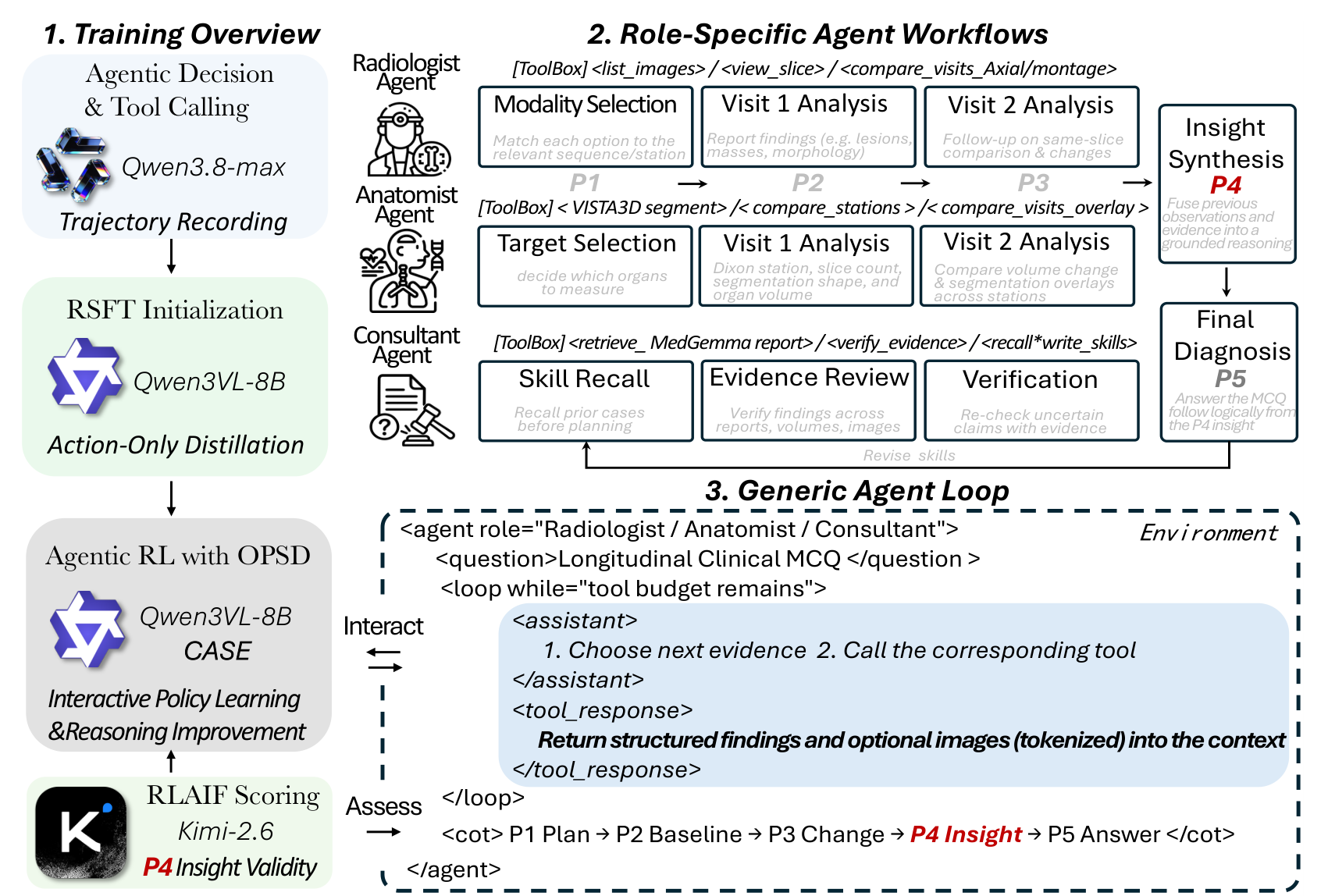
One shared policy instantiates three workflows, differing only by role prompt and tool registry. Every role ends with the same five-phase synthesis.
Organ and station measurements, longitudinal volume change, and segmentation overlays.
Selects acquisitions, then inspects and compares matched views across visits.
Combines images, volumes, MedGemma reports and skill memory; doubts and verifies claims. Uses all 10 tools.
Stage 1
Stage 2
Trajectory reward
L_j = b_j (0.5 c_j − 0.3 (1 − c_j)) · B_j = r^ans_j + 0.01 r^fmt_j + 0.6 s_j + L_j · R_{n,j} = sg[ B_j − 2 D^CKL_{n,j} ]
OPSD
The same frozen snapshot scores the trajectory under an ordinary view and an answer-privileged view. The reverse KL over the Phase-4 region (top-128 tokens plus one residual bucket) becomes a detached, trajectory-level penalty applied before group normalization. It reorders whole trajectories by synthesis quality without prescribing tool sequences.
Why: in mid-to-late RL the policy stalls in Phase 4, restating findings instead of committing. OPSD acts as a brake on this repetition.
RLAIF
Kimi K2.6 grades each Phase-4 insight on a rubric. Among the 8 rollouts of a group, the top-2 insights are linked to correctness: a strong insight is rewarded only when its answer is correct, and penalized otherwise, so persuasive but wrong synthesis is not reinforced.
+16%relative over GPT-5.4
+10%relative over Claude Opus 4.8
Under matched evaluation conditions, the Qwen3-VL-8B based CASE agent reaches 76.1 Micro / 75.1 Macro accuracy, ahead of every frontier model evaluated.
| Method | Micro | Macro |
|---|---|---|
| Base model | ||
| Qwen3-VL-8B (base) | 46.0 | 47.1 |
| Medical models | ||
| Lingshu-32B | 49.9 | 50.3 |
| Lingshu-7B | 45.5 | 46.7 |
| MedGemma-27B | 27.8 | 27.5 |
| MedGemma-1.5-4B | 40.5 | 41.4 |
| General multimodal foundation models | ||
| Kimi K2.6 | 42.8 | 42.0 |
| Kimi K3 | 70.2 | 69.5 |
| Qwen3.7-Plus | 67.0 | 67.7 |
| Qwen3.8-Max (teacher) | 59.7 | 58.3 |
| Gemini-3.5-Flash | 56.3 | 56.3 |
| GPT-5.4 | 65.3 | 65.7 |
| Claude Opus 4.8 | 68.6 | 65.8 |
| CASE (8B, ours) | 76.1 | 75.1 |
Efficiency
| Agent | Avg. calls | Median latency | Failure rate |
|---|---|---|---|
| CASE-8B | 5.1 | 34.2 s | 2.6% |
| GPT-5.4 | 4.3 | 46.1 s | 5.7% |
| Claude Opus 4.8 | 4.1 | 44.3 s | 5.2% |
| Variant | Micro | Macro | Insight [0,1] |
|---|---|---|---|
| RSFT only | 65.7 | 65.0 | 0.43 |
| GRPO | 69.3 | 68.2 | 0.47 |
| GRPO + RLAIF | 70.6 | 69.5 | 0.63 |
| GRPO + OPSD | 73.8 | 72.4 | 0.57 |
| GRPO + RLAIF + OPSD CASE-8B | 76.1 | 75.1 | 0.68 |
Each component adds on top of GRPO. RLAIF lifts insight quality the most on its own, while OPSD contributes the larger accuracy gain; combining both gives the best accuracy and insight score.
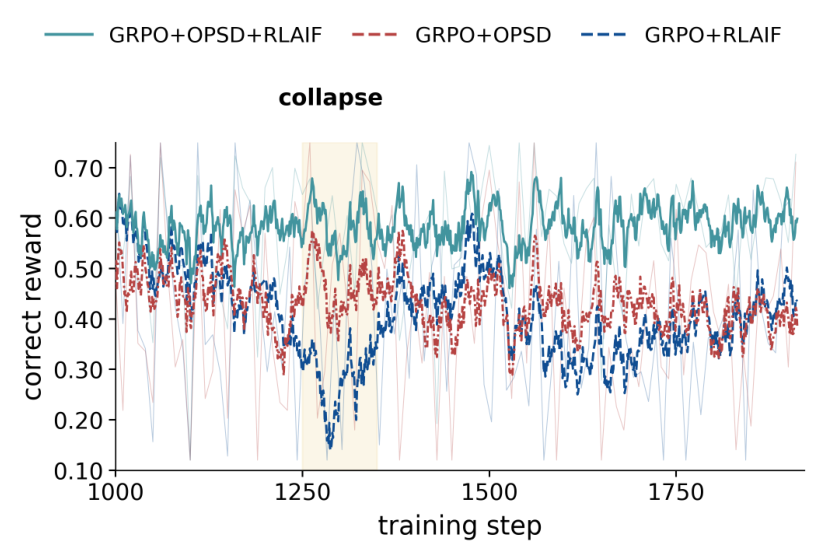
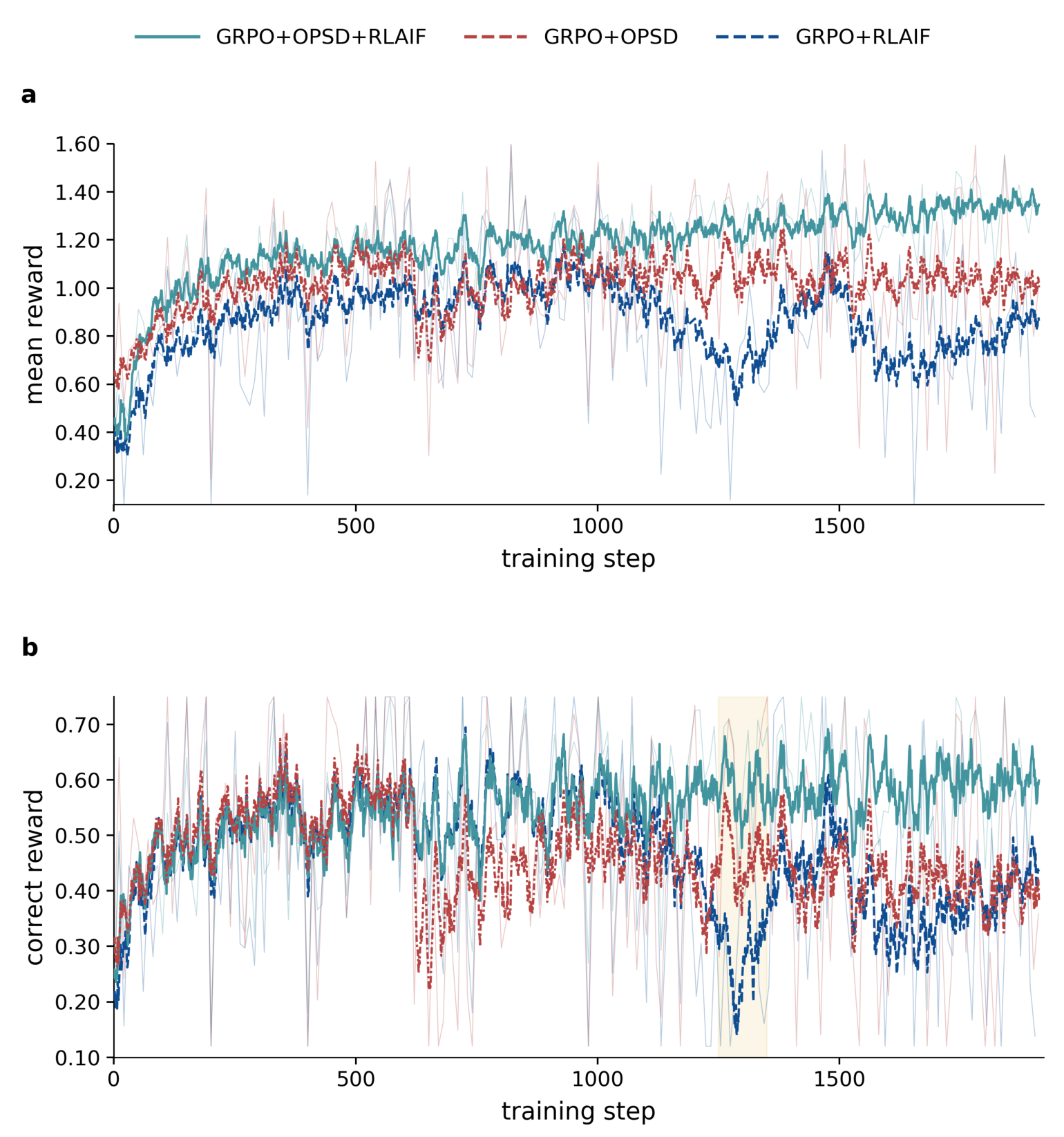
Late collapse without OPSD. In mid-to-late RL the policy tends to stall in Phase 4, restating findings instead of committing to an answer. Without the OPSD brake, GRPO+RLAIF's correctness reward collapses late in training (shaded band in Figure 3), whereas CASE-8B keeps improving.
Accuracy depends on what the agent can gather. Removing adaptive acquisition, or any evidence source, lowers accuracy — the largest drops come from answering the question alone or from initial context only.
| Evidence condition | Micro | Drop (pp) | Avg. calls |
|---|---|---|---|
| Question only | 38.6 | 37.5 | 0 |
| Initial clinical context | 52.7 | 23.4 | 0 |
| Fixed evidence packet | 66.0 | 10.1 | 0 |
| Adaptive acquisition, all sources | 76.1 | — | 5.3 |
| Adaptive, without MRI views | 65.9 | 10.2 | 4.7 |
| Adaptive, earlier visit only | 64.6 | 11.5 | 3.9 |
| Adaptive, without reports | 71.7 | 4.4 | 3.7 |
Interactive trajectory walkthrough — coming soon. Below is a static summary of one Consultant trajectory.
Which hepatic conditions apply to this participant?
Reference answer: {A, B}
recall_skills(liver)“Stable lesions without invasive characteristics are less suggestive of malignancy.”
list_available_imagesLiver IDEAL, whole-body Dixon, pancreas.
compare_visits(IDEAL multiecho, V1 vs V2)Diffuse fat-related signal increase; persistent focal lesion without enlargement.
view_image(Dixon 8_W, V1, slices 10/22)Well-circumscribed lesion, smooth contour, no invasion.
compare_visits(Dixon slice 22)Lesion stable; steatosis progression.
vista3d_compare_visits(liver)1150.8 ml → 1263.4 ml +9.8%
get_report(liver, impression)Steatosis, hepatomegaly, focal lesion needing characterization.
get_report(wholebody, findings)No confirmed liver cancer.
The decision is whether the lesion is malignant — stable, no invasion, no oncological history → benign lesion plus steatosis.
Matches the reference {A, B}.
write_skillRecords the lesson for future cases.
Coming soon.